
Most marketers still evaluate discovery by opening dashboards like Ahrefs, Semrush, or Google Search Console where traffic looks stable, rankings appear intact and a few keywords have moved up or down. Nothing stands out as urgent or concerning.
Then, someone shares a screenshot from ChatGPT.
It shows a user question where your brand should ideally be present but instead, a competitor is described as a category leader and your name is missing completely. There is no link and no attribution – just a single sentence that quietly removes you from consideration.
That moment does not show up anywhere in your analytics stack but it is real. And, it is happening far more often than most teams realize.That gap is where AI discovery metrics begin.
Where Traditional SEO Measurement Quietly Stops Working
Traditional SEO tools like Ahrefs, Semrush, and Search Console are very good at measuring what they were designed to measure – pages, links, queries, and clicks. They all work under the same assumption that discovery happens through interaction where a user searches, evaluates results, and eventually clicks on the link.
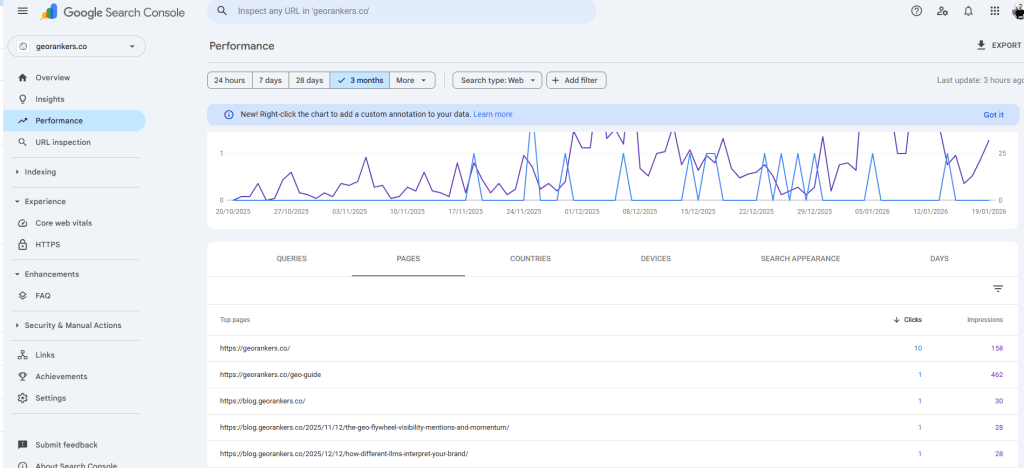
But, AI-driven discovery does not follow that model.
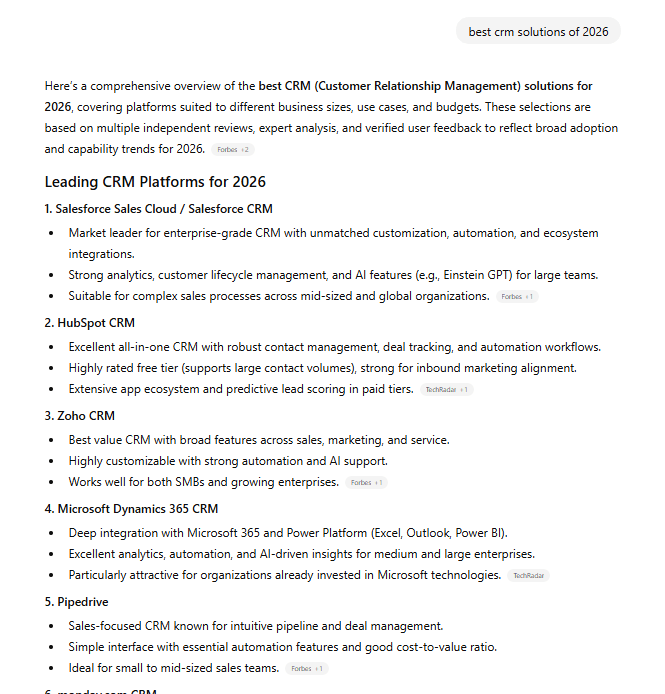
In LLM-generated responses, brands surface as language rather than just a destination. They are framed, compared, and sometimes ruled out entirely without the user ever leaving the interface as the influence is created much before intent becomes explicit and before any measurable action takes place.
This is why many teams are feeling an increasing disconnect with the change. It’s not that they are not doing anything wrong by traditional SEO standards but yet something has clearly shifted.
What AI Systems Are Actually Optimizing For
LLMs do not think in rankings or URLs – they operate on learned associations.
When a model answers a question, it is drawing from repeated patterns it has seen across many contexts. It is assembling a response based on familiarity, consistency, and perceived consensus.
This is subtle but a very important shift as a brand can now be technically visible and still be conceptually absent. Another can have limited organic strength and still be deeply embedded in how the model understands a category.
Once you see this, it becomes clear that visibility today has split into two layers – one that SEO tools see and another that sits entirely inside generated language.
The Metrics That Reflect AI Discovery – Not Page Performance
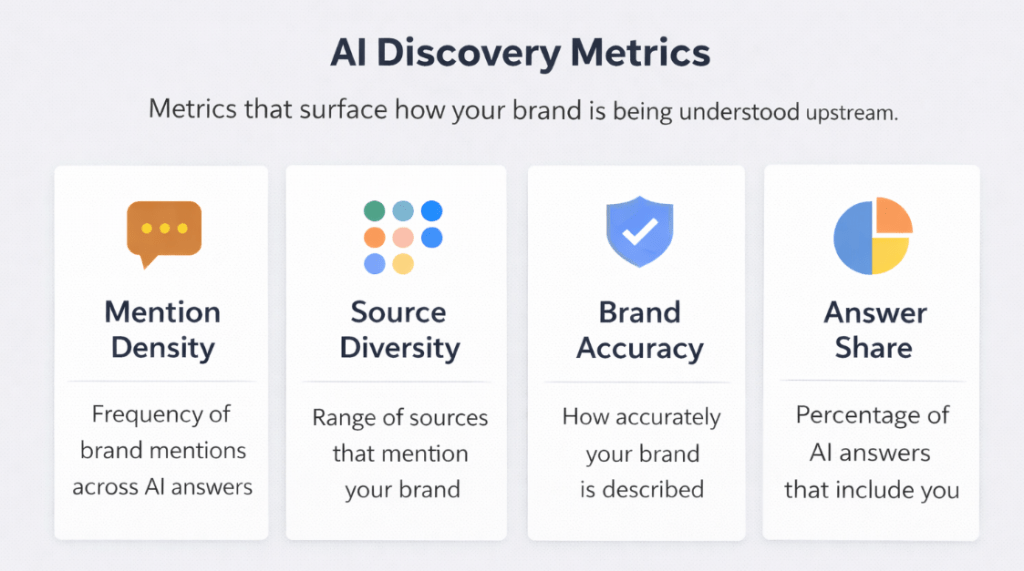
These metrics are not just theoretical frameworks but emerge naturally once you start observing AI answers at scale and asking better questions about what is happening inside them.
Mention Density
Mention density is simply the frequency with which your brand appears across AI answers that matter to your buyers.
Not just once in a single demo prompt but repeatedly across variations of the same intent. When a brand shows up again and again, it becomes familiar and soon this familiarity turns into default inclusion even before preference is formed. This actually mirrors how people tend to remember brands in conversations not just how they discover links.
SEO tools cannot surface this because they never see the answers – they measure exposure through pages. Mention density, on the other hand, lives entirely inside generated responses.
Read this article to see how you can earn mentions that AI trusts.
Source Diversity
Over time, you start noticing something else – when a model mentions your brand, it is rarely drawing from a single source.
Strong AI visibility tends to correlate with brands that appear across many independent sources – reviews, community discussions, technical documentation, explainers, comparisons. The specific mix varies but the pattern is consistent.
LLMs trust repetition across difference. Therefore, while a single authoritative source helps, but, it does not anchor the understanding of the models the way distributed confirmation does.
And this is where backlink metrics quietly fall short as they treat all citations as structurally similar while AI systems weigh them very differently.
Brand Accuracy
This is the metric most teams do not realize they need until it is already a problem.
AI may mention your brand frequently but might describe it incorrectly – wrong audience, wrong use case or a wrong category framing.
Once that description starts repeating, it becomes the default mental model the AI system carries forward. And the biggest challenge is that fixing it later is significantly harder that to prevent it earlier.
Accuracy here is not so much about sentiment but about alignment of how AI explains your product and how your customers would explain it.
No SEO platform is built to measure this narrative correctness and this requires semantic comparison – not just ranking analysis.
Answer Share
Answer share measures how often your brand is included when the model names options – not whether it dominates the list.
Over time, brands with high answer share become the ones that naturally belong in the category while the others feel optional even if they are objectively strong.
This type of competitive presence simply does not exist in keyword tracking tools because it requires analysing full answers and not just individual mentions.
Why These Metrics Matter More Than They Sound
These metrics feel abstract until you connect them to what happens in the funnel downstream.
Sales conversations are increasingly starting with fewer brands in consideration and buyers often arrive having already formed an opinion before visiting a website. By the time they book a demo, they have a good idea about your product’s strengths, limitations, and positioning shaped quietly by what AI systems have already told them.
But when teams rely only on traffic and ranking data, they end up measuring demand only after it has already been influenced. This is where tracking AI discovery metrics helps.
These metrics surface how your brand is being understood before intent becomes visible giving teams a way to see the part of discovery that traditional SEO analytics simply never captured.
This does not mean that AI discovery is replacing SEO – it simply means that discovery now begins earlier in a layer where language shapes perception long before pages are visited or rankings come into play.
A Simpler Way to Think About the Shift
SEO metrics tell you how visible your content is while AI discovery metrics tell you how visible your brand is inside language.
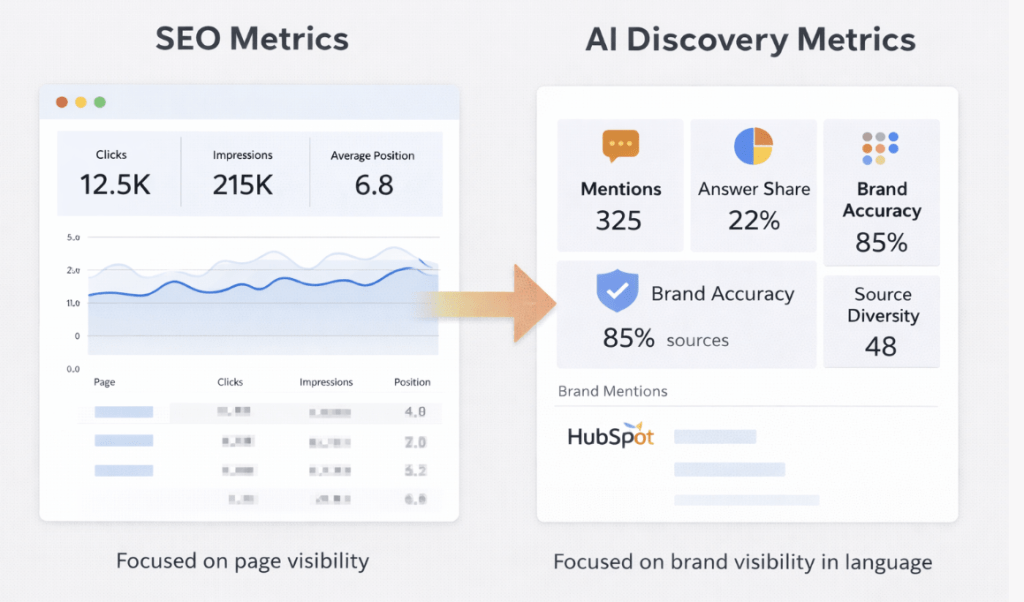
Both things matter as they answer different questions and pretending one can substitute for the other is what creates blind spots.
This is similar to how brand search volume once felt intangible compared to direct response metrics. Ignoring it did not make it irrelevant – it just delayed the understanding.
Conclusion
Discovery has moved upstream away from clicks and toward explanations. Metrics like mention density, source diversity, brand accuracy, and answer share exist because buyer behavior has changed – not because someone wanted to invent new jargon. They describe how brands are understood and recommended inside systems that now shape decisions before a single visit happens.
SEO tools cannot show these signals because they were built for a different model of discovery that was centered on pages and interactions rather than synthesized understanding. That does not make it obsolete but it does make them incomplete in today’s context.
As AI systems increasingly sit between buyers and brands, the ability to see how your company is explained, compared, and remembered becomes a strategic advantage. The real risk is not that discovery is changing – it is that it is changing quietly outside the dashboards most teams still rely on.
Frequently Asked Questions
1. What are AI discovery metrics?
AI discovery metrics are measurements that explain how a brand is surfaced, described, and compared inside AI-generated answers. Unlike traditional SEO metrics that focus on rankings and clicks, these metrics track how often a brand is mentioned, how accurately it is described, and how consistently it appears across AI responses before a user ever visits a website.
2. How are AI discovery metrics different from SEO metrics?
SEO metrics measure page-level visibility, such as impressions, clicks, and keyword rankings. AI discovery metrics measure brand-level visibility inside language, including brand mentions, positioning, and presence within AI answers. SEO shows how content performs after discovery, while AI discovery metrics explain how discovery itself is happening upstream.
3. Why can SEO tools not track AI discovery properly?
SEO tools are built to analyse search engines that rank pages and drive clicks. AI systems do not rank pages in the same way and often generate answers without linking to sources. Because SEO tools do not capture AI responses or analyse generated language, they cannot measure brand mentions, answer share, or brand accuracy inside AI outputs.
4. What is mention density in AI discovery?
Mention density refers to how frequently a brand appears across a set of AI-generated answers related to a category or problem space. Higher mention density indicates stronger AI-level visibility and familiarity, even if the brand does not rank first for traditional search keywords.
5. What does brand accuracy mean in LLM analytics?
Brand accuracy measures how closely AI-generated descriptions of a brand match its intended positioning, use cases, and target audience. A brand can be frequently mentioned but inaccurately described, which can negatively influence buyer perception long before a sales conversation begins.
6. Are AI discovery metrics replacing SEO?
No. AI discovery metrics do not replace SEO but sit above it. SEO remains critical for capturing demand once users visit websites. AI discovery metrics explain how demand is shaped earlier, inside AI systems where buyers form opinions, shortlist vendors, and build context before engaging with search results or landing pages.


 GeoRankers Blogs
Leave a comment