A few years ago, brand discovery followed a relatively predictable path where teams focused on identifying the right keywords, investing in content, earning backlinks, and waiting for traffic to compound over time. While that model still exists and continues to work in certain contexts, it no longer explains how people actually discover software today.
Increasingly, discovery begins with a question typed directly into an AI interface and the response that comes back feels less like a list of search results and more like a considered opinion that has already weighed options, trade-offs, and outcomes.
What matters most in this shift is not the interface itself but the input layer feeding those answers because every confident recommendation an AI produces is built on a long trail of human conversations that happened elsewhere, often long before the question was ever asked.
This shift quietly changes what visibility means, how trust is formed and where brands should focus if they want to be recommended rather than simply indexed.
The Quiet Shift From Pages To People
Traditional SEO trained marketers to think in terms of pages, crawlability, keywords and ranking positions which implicitly assumed that discovery happened at the document level.
AI search operates on a different logic. These large language models do not just retrieve a single best page and present it as the answer, but instead synthesize patterns across many sources and compress them into a response that sounds coherent and confident.

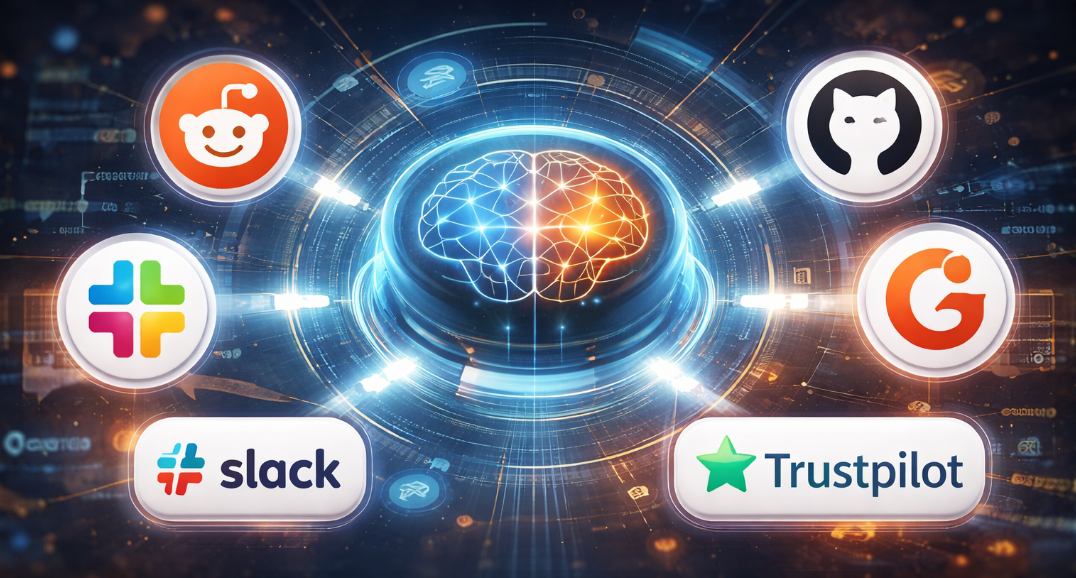
When an AI suggests a tool, framework, or vendor, it is rarely pointing to the most optimized blog post in isolation but is instead reflecting a consensus that has already formed across many communities such as Slack groups, Reddit threads, GitHub, and review platforms where user feedback & experience outweighs positioning.
These talks are messy, full of opinions, and very human, which is exactly why they are important because that is the kind of language AI systems use to learn what a helpful answer should sound like.
Why Keywords Matter Less Than Shared Narratives
Keywords still play a role as they help structure information and clarify intent. However, what they do not do is create belief the way communities do, especially in an environment where AI systems learn from repeated human judgment rather than isolated signals.
When dozens of practitioners independently describe a product in similar terms over time, AI models begin to associate that brand with a specific role, outcome, or reputation. If one community repeatedly describes a tool as dependable at enterprise scale while another consistently frames it as powerful but slow to onboard, both narratives exist simultaneously and AI generated answers tend to reflect whichever framing appears most stable or most frequently reinforced across sources.
This is why two products with nearly identical feature sets can receive very different AI recommendations because from an AI perspective keywords function largely as labels, while communities provide the meaning behind those labels.
Communities As The New Trust Layer
For a long time, trust in search was inferred indirectly through links which acted as endorsements and helped approximate authority in a web built around documents.
But AI systems operate differently. In these systems credibility is shaped less by where a page ranks and more by how ideas circulate across real conversations.
Instead of relying on links or mentions, AI models understand trust by observing how people talk about products across independent discussions, especially when similar experiences and opinions keep appearing over time.
What stands out in these conversations is not how a brand positions itself but how users describe what actually happened after they started using the product. Community discussions matter for this reason because they are rooted in real usage.
People talk openly about what worked, what did not, and what only became clear after spending time with a product. When AI systems see these experience driven descriptions repeated across different conversations, they treat that consistency as a credibility signal which is why a single detailed discussion can outweigh a large volume of polished content when recommendations are generated.
Where AI Platforms Actually Pick Up Community Signal
When people hear that communities influence AI search, it can sound abstract but it becomes easier to understand once you pay attention to how AI answers are phrased.
Many of those responses do not sound like articles or landing pages – they sound like someone thinking through a decision with a few caveats, some hesitation, and the occasional strong opinion.
That tone does not come from optimized content – it comes from the same places where practitioners talk to each other without trying to be visible or persuasive. Over time, AI systems absorb these language patterns from a fairly consistent set of community driven sources such as Reddit, Stack Overflow, GitHub discussions, G2, Capterra, Hacker News, and niche Slack or Discord groups.
| Community Type | Examples | How AI Models Pick Up Signal | How Brands Actually Win There |
|---|---|---|---|
| Open Discussion Forums | Reddit, Hacker News | AI models absorb how people debate, disagree, and qualify opinions over long threads, especially when similar views repeat across independent users | Participate selectively, respond with context not promotion, and allow users to explain their own experiences without correcting or reframing them |
| Developer Q&A Communities | Stack Overflow | Models learn practical framing from accepted answers, comments, and edge case discussions rather than official documentation | Help solve problems without branding every response, acknowledge limitations openly, and let usage speak for itself |
| Code And Product Repositories | GitHub | Repeated issues, feature requests, and discussion threads shape how AI understands real world usage and constraints | Be responsive, transparent in issue discussions, and consistent in how tradeoffs are explained rather than defensively closing conversations |
| Software Review Platforms | G2, Capterra | AI systems pick up sentiment patterns around onboarding, support, pricing, and reliability even when reviews are not directly cited | Focus on fixing repeated complaints, encourage honest reviews post onboarding, and avoid scripting feedback |
| Private Professional Communities | Slack groups, Discord servers, closed forums | Language formed here often leaks into public posts, blogs, and threads that AI systems later ingest | Earn trust through long term presence, share lessons learned, and resist the urge to control how users talk about you |
| Niche Industry Communities | Role specific forums, founder groups, operator networks | Small but consistent narratives can disproportionately shape category level AI explanations | Identify where your ICP actually talks, show up as a peer not a vendor, and let others describe value in their own words |
What matters is not that AI systems read any one of these platforms directly but that the language used in private conversations often shows up later in public posts, comments, or blogs. By the time AI systems ingest this language, the original context has disappeared even though the framing remains intact.
For brands, this creates an uncomfortable reality where AI visibility is shaped long before anyone visits their website and is influenced by conversations they did not script, control, or sometimes even know were happening.
Read – From Rankings to Reasoning: Mapping Content Influence in AI Search
The New Battleground For Brand Discovery
Brand discovery is no longer determined solely by what lives on your site or in your content calendar but is increasingly influenced by places you do not own and often do not monitor and this is where the battleground is shifting . Many buying journeys now begin with explicitly trust driven questions such as what tools founders actually use, whether a product is worth the price, or what the hidden downsides might be.
These are not keyword driven queries but judgment calls and AI answers them by summarizing what people have already said elsewhere. If your brand is absent or poorly represented in those conversations, your chances of being recommended drop sharply regardless of how strong your traditional SEO fundamentals may be and ignoring these spaces does not make their influence disappear but simply allows the narrative to form without you.
A Mental Model Shift For Founders And Marketers
A useful way to understand AI search is to think of it as a well-read analyst that has absorbed thousands of conversations, articles, and opinions and is now being asked to form a view. It does not ask which page ranks first but instead asks what the collective evidence suggests.

In this model, communities are not top of funnel noise but primary training data and the goal is not to dominate those conversations but to participate in ways that reinforce a clear and accurate narrative about what your product does and where it fits.
This requires a shift in the questions teams ask internally such as where real users discuss the problem, how the product is described when the team is not present, and whether the same strengths and weaknesses are being repeated across different communities.
These questions are harder to answer with traditional analytics but they are far more aligned with how AI systems actually learn.
Read – A Strategic Guide for B2B and SaaS Marketers
What Brands Get Wrong About Community Presence
Most brands approach communities with the wrong intent from the start.
They see them as another place to distribute links or messages and when those posts do not change perception or generate engagement, they quietly disengage, assuming the channel does not work. In reality, that approach often does more harm than good because communities are very quick to sense when someone is there to promote rather than participate.
What tends to work is far less performative. Teams show up to answer questions, share context and acknowledge where their product does not fit without trying to turn every interaction into a pitch. Over time, those small interactions accumulate into a pattern of language that feels credible and that is the kind of material AI systems later reuse when forming recommendations.
Another mistake is assuming that only large, visible platforms matter. In reality, some of the strongest opinions about a category are formed inside small, focused groups where people share similar problems and talk more candidly. A single respected community can shape how a product is talked about far more than content designed for reach.
Many brands also underestimate the cost of absence. When a brand is not part of the conversation while others still are, over time those external voices end up defining the narrative by default.
From Monitoring To Intentional Shaping
A new discipline is emerging around AI discovery where it is no longer enough to monitor mentions but becomes essential to understand how a brand is being framed across communities and how those frames influence AI generated answers. This does not mean manipulating conversations but aligning product reality, messaging, and community engagement so that the same story is reinforced consistently by users themselves.
When that alignment exists, AI systems become more confident in associating a brand with specific outcomes, recommendations become more precise, and discovery improves without any visible change in rankings.
The Future Of AI Discovery Is Social, Not Algorithmic
AI search may look technical on the surface, but its inputs are deeply social because it is built on language and language is shaped by people talking to each other.
For founders and marketers, this means discovery moves upstream and begins earlier in conversations that feel informal and difficult to measure yet increasingly determine whether a brand shows up at all when AI is asked for guidance.
The brands that win will not be the loudest, but the ones that are consistently understood.
Frequently Asked Questions
1. How do communities influence AI search results?
Communities influence AI search results because large language models learn from how people talk about products and ideas across many real conversations, not just from published articles or brand content. When similar opinions, experiences, and caveats appear repeatedly in community discussions, AI systems begin to reflect that shared understanding when generating answers and recommendations.
2. Why do AI tools recommend some brands more often than others?
AI tools tend to recommend brands that have a clear and consistent narrative across community conversations, because repeated descriptions help models associate those brands with specific outcomes or use cases. When a product is frequently discussed in practical, experience driven terms, AI systems gain more confidence in recommending it compared to brands that only appear in polished marketing content.
3. Are keywords still important for AI search visibility?
Keywords are still useful for structuring content and clarifying intent, but they are no longer sufficient on their own to influence AI driven discovery. AI systems rely more on how a brand is described across conversations, which means shared narratives and community perception now play a much larger role in shaping visibility than keywords alone.
4. Which online communities matter most for AI search?
AI systems tend to reflect language and opinions that originate in practitioner led spaces such as forums, developer communities, review platforms, and private groups where people speak candidly about real usage. What matters more than the platform itself is the quality and consistency of the conversation, especially when similar experiences surface across multiple communities.
5. How can brands improve their visibility in AI generated answers?
Brands can improve AI visibility by actively participating in relevant communities in a genuine way, answering questions honestly, sharing real context, and allowing users to describe their experiences without heavy intervention. Over time, this creates a consistent body of language that AI systems can learn from when forming recommendations.
6. How is AI search different from traditional SEO?
Traditional SEO focused on optimizing pages to rank for specific queries, while AI search focuses on synthesizing opinions and experiences into a single answer. Instead of asking which page ranks highest, AI systems ask what the collective evidence suggests, which is why community conversations now play a central role in discovery.



Leave a Reply