
A friend of mine in Marketing recently said something that stuck with me – “We used to obsess over page one. Now my buyers don’t even open Google – they just ask ChatGPT.”
That casual remark sums up a bigger shift.
Google rolled out AI Overviews and ChatGPT, Perplexity and other assistants got into mainstream search behaviour pretty soon after that. Suddenly your audience is not scrolling down to find your carefully optimized article but, they are reading a neatly summarized answer at the very top.
If your traffic has dipped even though your keyword rankings look healthy, you are feeling the impact of this shift.
The Great Traffic Vanish
When Google’s AI Overview appears at the top of the results page, users see a synthesized answer box rather than a list of links.
Marketers are reporting that impressions in Search Console remain strong while clicks drop. According to Opollo’s Steven Morey, businesses are seeing their informational content show up in results but not receiving visits because the AI answer box intercepts that traffic.
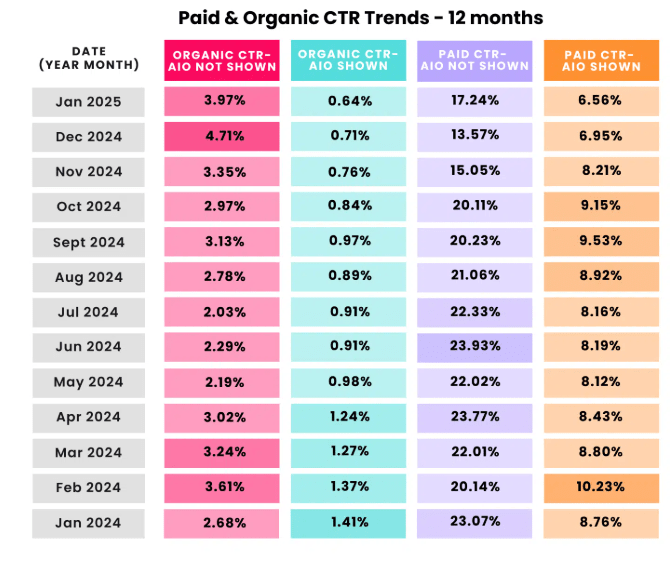
Studies show that click‑through rates have declined by up to a third when AI summaries appear and more than half of all searches now end in zero clicks. A similar study by Semrush’s study of 10,000 informational keywords shows that AI‑generated summaries reduce organic click‑through rates by between 18 and 64%.
But the real story is not just about lost clicks – it’s about a change in how discovery works. Ranking on page one used to guarantee visibility but now that visibility depends on whether AI considers your content authoritative enough to weave into its own answer. That is a fundamental rewiring of the funnel – your brand is competing not only with other websites, but with the AI summary itself.
The old equation of rank high and get traffic is now replaced with a new equation – get selected inside the summary, or risk being invisible.
Ranking Isn’t What It Used to Be
If clicks are dropping even when you rank well, the natural question that rises is why isn’t ranking protecting me anymore?
The answer to this lies in how generative AI chooses its sources.
AI models work differently – instead of weighing the authority of a full page, they scan for discrete paragraphs or passages that directly answer a query. That’s why a blog buried on page three can still be pulled into an AI response, while a polished #1 result gets ignored.
Having said that, rankings have not lost all their influence. ProRankTracker’s mid‑2025 experiments showed that ChatGPT’s web results relied heavily on Bing rankings and Perplexity and Gemini relied on Google rankings. But the relationship is bit loose and unpredictable as in nearly a quarter of local and niche searches, neither Google nor Bing’s top result appeared in any AI-generated answer.
The implication is clear: ranking high may still matter for traditional search traffic, but it is no longer enough in this AI era. What matters now is whether your content is structured, quotable, and trustworthy enough for these model to pick them up.
The implication is clear – ranking high may still matter for traditional search traffic, but it is no longer enough. In the AI era, what matters most is whether your content is structured, quotable, and trustworthy enough for the model to select.
Traffic Quantity vs Quality
AI Overviews and ChatGPT have reduced the clicks but multiple studies have found that the people who still land on your site via these usually come with a stronger intent.
By the time they reach you, they have already scanned the options in the AI summary and they are not just browsing anymore but checking whether you are the right fit.
That’s exactly what both WordStream and Semrush highlight in their research – visitors from AI search are more valuable!
The research notes that AI handles surface-level content easily, but it struggles to compress deeper work – things like detailed guides, proprietary data, or case studies still attracts clicks. And, when someone click through from an AI summary, they are far more valuable and convert at more than four times the rate of a typical organic visitor.
To put simply, you may be getting fewer visitors, but the ones who do arrive are often closer to making a decision. That makes the quality of your content and its ability to be selected by AI even more important.
How We Got Here
The surge of generative AI in search did not happen overnight. Google launched its Search Generative Experience (SGE) in May 2023 and started rolling it into their search through AI Overviews.
Meanwhile, ChatGPT reached over 800 million weekly active users by April 2025 and began testing its own Search GPT engine that provides answers from the web.
Fractl and Search Engine Land found that 39% of marketers noticed traffic declines after AI Overviews launched in May 2024 with the steepest drops in technology (44%), travel (43%) and retail/e‑commerce (35%).
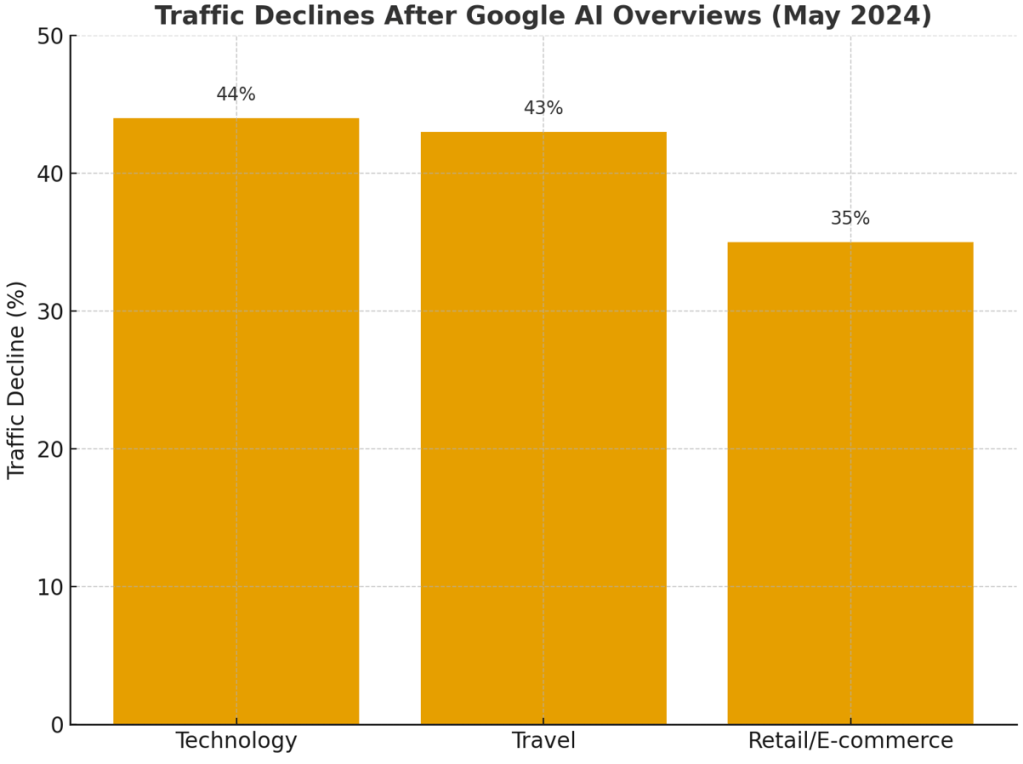
These industries were not hit hardest by accident.
The companies in these sectors compete on highly searchable “how-to” and product comparison content – the exact type AI can summarize quickly. Travel relies on quick answers for destinations, itineraries, and tips, which generative engines condense into neat overviews. And in retail, shoppers rarely need to click through when product specs and pricing can be pulled straight into the AI box.
What these examples reveal is that the sectors most dependent on top-of-funnel visibility are also the most exposed. When discovery gets compressed into a few lines of generated text, entire content strategies built on organic reach can lose their leverage almost overnight.
How to Be Summarised and Cited
The era of AI search does not make SEO irrelevant but transforms it. The goal now should not be to just to rank but to ensure your content appears in AI‑generated summaries. Here’s how to increase your odds of showing up in those summaries –
Quality Over Quantity
Publishing a dozen light blog posts a month will not help anymore as Generative engines don’t reward volume – they reward authority and depth.
Think of it this way – AI is trained to compress information and if your article is thin, it disappears in the compression. But a detailed guide with proprietary data or a unique perspective is harder to flatten, which makes it more likely to be cited.
We are already seeing this – AI search visitors convert almost 5 times better because they are clicking through the content that survived the summary stage.
Instead of chasing keywords, put your effort into creating cornerstone pieces – a definitive explainer, a research-backed whitepaper, or a case study that no one else can replicate.
Make Your Content Quotable
AI does not read like humans – it skims for structure. Headings, bullet points, and direct answers act as signposts for models. Think of your content as a library of quotable blocks – if the model can easily lift a passage as a clean, standalone answer, you are more likely to get cited.
This is where formatting becomes strategy.
Start sections with a clear question (H2 or H3) and give the most direct answer in the first few sentences and add more context in the later sections. Do focus on schema markup including FAQ, How To, Product etc. but don’t just rely on the them alone – your plain-text content needs to be equally reference-ready.
Improve Technical Visibility
AI crawlers need to access and understand your pages. Google bots are obvious, but OpenAI, Anthropic, and Perplexity all send their own crawlers to pick up the right content. Ensure that you are not blocking them in your robots.txt file.
Here’s a simple example of a robots.txt file that allows Google, OpenAI, Anthropic, and Perplexity crawlers –
# Allow all major AI crawlers

User-agent: Googlebot

Allow: /

User-agent: GPTBot

Allow: /

User-agent: Anthropic-AI

Allow: /

User-agent: PerplexityBot

Allow: /

# Default: allow everything

User-agent: *

Allow: /
Beyond access, ensure that you have clean sitemaps, fast load speeds, and mobile-first design to make it easier for models to process your site. Structured data is not just for rich snippets anymore but it’s one of the clearest signals to AI systems about what your content means.
Build Brand Authority
Semrush’s analysis shows that AI search visitors convert better because they view AI responses like personal recommendations.
And hence, building brand authority through thought leadership, recognition, and PR mentions should no longer be seen as a nice-to-have activity. These signals are read by AI models as strong indicators of credibility, which improves your chances of being cited.
It’s not about gaming algorithms—it’s about becoming the kind of source models trust to represent an entire category.
Monitor and Adapt
You cannot manage what you can’t measure. Traditional rank trackers focus on Google’s SERP, and while platforms like Ahrefs and Semrush now surface AI visibility, they are still limited.
They give you a snapshot of whether your brand shows up but they don’t yet provide the deeper insights that tell you why you were included or what you can do to improve. That’s the real gap – marketers can see mentions, but they don’t have the levers to turn those mentions into consistent visibility.
That’s the gap we are trying to fill at GeoRankers. Instead of just telling you if your brand appears in ChatGPT, Gemini, or Perplexity, GeoRankers goes deeper –
- Citation tracking across multiple LLMs – see not just if you are mentioned, but where and in what context.
- Source analysis – understand which pieces of your content are driving citations and which competitors are being favoured.
- Actionable insights – get recommendations on how to restructure, enrich, or expand your content so models are more likely to select it.
- Brand visibility scoring – track how your authority inside AI search shifts over time, the same way you track keyword rankings today.
The idea is not just to monitor AI visibility but to make it actionable. Because in the AI-search era, knowing you have been left out is not enough – you also need to know how to get back in.
The Future of Search
All evidence points toward a hybrid future where search engines blend AI summaries with links. Google’s AI Mode is already being tested and if adopted widely, it could replace the familiar SERP for many queries.
Semrush projects that AI search could surpass traditional search by 2028, and some analysts argue it could happen even sooner if adoption of AI Mode accelerates. ChatGPT’s own experiments with Search GPT and Perplexity’s rapid growth show that this is not just a Google experiment – it’s a broader shift in how people discover information.
That said, the open web still matters.
Google executives have repeatedly promised they will continue to send traffic to publishers. Early usage data suggests a split – homepage visits are rising, but deep-content clicks are falling. In other words, more users are navigating directly to brands they already know, while fewer are discovering new sites through long-tail queries.
This hints at a more uneven playing field. Well-known brands with strong authority may benefit from increased direct engagement, while smaller sites risk being bypassed unless they can win citations in AI summaries. The middle of the web – the thousands of helpful but less differentiated blogs that once thrived on SEO may feel the squeeze first.
For B2B SaaS marketers, this future means discovery will no more hinge only on whether you rank in Google but on whether AI models see you as credible enough to represent the category. That makes brand authority, structured content, and AI visibility not side projects, but the foundations of marketing strategy in the years ahead.

Frequently Asked Questions
1. Why is traffic falling even though my site still ranks on Google?
AI Overviews often give users the full answer on the results page. That means fewer clicks, even if you hold the top spot. The solution is to create content that goes beyond quick answers—detailed guides, proprietary research, and context that AI can’t fully summarize.
2. Which types of businesses are most affected by AI summaries?
Industries that rely on quick-answer content are most exposed. Travel, retail, tech, and publishing see sharper drops because AI can condense product details, itineraries, or definitions into a few lines. To reduce risk, shift focus to mid- and bottom-funnel content that reflects unique expertise.
3. How should B2B SaaS adjust to this shift?
B2B SaaS brands need to publish assets that AI models treat as authoritative. Think customer case studies, benchmark reports, and step-by-step frameworks. These give your brand visibility inside AI-generated answers and position you as the source buyers can trust.
4. Does SEO still matter if AI is summarizing answers?
Yes – SEO is still the foundation. Search engines and AI models both rely on structured, crawlable content. But the bar has moved – schema markup, citations, and well-organized headings are now just as important as backlinks or keywords to ensure discoverability.
5. What type of content is resistant to being over-summarized?
Content that delivers unique value. Original research, proprietary data, or detailed industry playbooks are harder to compress into a generic summary. These assets make AI engines reference your work instead of replacing it.
6. How do I check if AI tools are already using my content?
It’s still early, so tracking is limited. You may see unexplained “Direct” or odd referral traffic in analytics, which sometimes comes from AI systems. Dedicated visibility tracking is emerging to fill this gap helping brands understand where they are showing up in AI answers.
7. Is being summarized always a bad thing?
Not necessarily. You may lose raw clicks, but if your brand is mentioned inside the AI response, you are influencing buyer perception at the decision stage. The key is to measure presence in AI answers, not just traditional traffic.


 GeoRankers Blogs
Leave a comment