
For most of the time that the internet has been around, being on the top page of Google was the best thing that could happen. The higher your brand appeared, the more likely you were to capture clicks, generate leads, and grow.
But, the way people look for information is no longer limited to typing queries into a search bar. Increasingly, they are asking AI systems like ChatGPT, Gemini, or Perplexity for answers and these tools don’t give you just a list of links to choose from. They summarize, synthesize, and recommend.
This change make you ask an uncomfortable question – what happens when your carefully built SEO playbook that you spend years building in no longer guarantees your brand’s visibility in the channels where buyers are now starting their search?
Why SEO Alone Is No Longer Enough
Traditional SEO has never been more advanced than it is today.
Brands spent years getting their keyword strategies, technical optimization, and backlink acquisition just right. But the basic idea behind SEO has always been that people will go to a search results page, look at the choices, and then click on a link to a website.
But evolution of Generative AI has disrupted that flow.
According to Gartner, by 2026, 25% of the search engine volume will drop as users will turn to AI assistants as their primary discovery tool instead of traditional search engines.
If a buyer asks ChatGPT for the “best project management software for remote teams,” the answer they see might contain a shortlist of three or four tools and your brand may not appear at all, even if you rank highly on Google.
This does not mean SEO is no longer useful. Rather, it means that SEO in its current form is incomplete.
To remain discoverable, brands need to change their approach to a version of search optimization which includes AI systems as a key part of their distribution strategy.
A New Way to Think About SEO
If SEO was about ranking in an index, GEO or Generative Engine Optimizations as it is being popularly called now, is about being selected as part of an answer. AI models are trained on a mix of web content, structured data, and external references. They don’t reward for basic keyword matching. Instead, they search for information that is genuine, well-structured, and can be used with confidence in a response.
This is why some brands surface more often than others in AI-generated results.
Let’s take Gong – a revenue intelligence platform. Their research-backed Gong Labs studies are frequently cited by blogs, analysts, and even AI models. Their content isn not just on their own website but is also widely circulated in authoritative places, which makes it more likely that an AI assistant will use it.
In contrast, its competitors have focused more on traditional keyword driven blogs or product updates but not so much on becoming part of industry case studies or reports from reputed analysts like Forrester, Gartner etc. This is why in AI search these brands don’t have same level of authority as Gong. The difference here lies in whether a brand’s content is structured, referenced, and trusted enough to become part of the AI knowledge graph.
An analogy helps here – if traditional SEO is like putting up a bright storefront on a busy street, GEO is like making sure the hotel concierge knows your business well enough to recommend it to its guests.
The recommendation here has less to do with how easy it is to see your store sign and more to do with whether or not you are seen as trustworthy.

Traditional SEO vs AI Search Optimization
The practical differences between these two approaches become clearer when you compare their focus areas side by side –
| Traditional SEO | AI Search Optimization or GEO |
| Keywords and search volume | Entity level clarity (brand associated with a category or topic) |
| Backlinks as primary authority signal | Structured data, schema, and machine-readable content |
| Content written for human skimming | Content designed for synthesis into answers |
| CTR and engagement time as performance metrics | References and citations across multiple sources |
| Focus on your own website | Visibility across analyst reports, review sites, and community forums |
This table makes one thing clear – GEO does not replace the basics but builds on top of it.
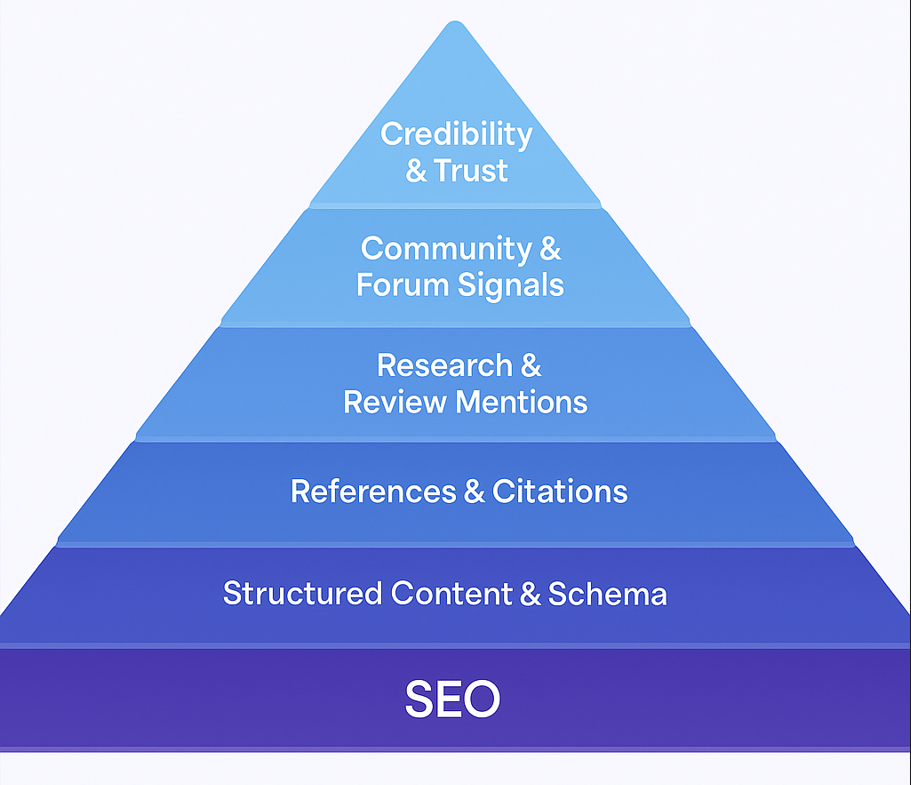
You won’t even be found if you don’t have good SEO practices along with high-quality content. But, companies now has to also make sure that these LLM models can easily access, understand, and remember information about their products in order to be surfaced in an AI-first future.
The Transition Plan: Making SEO Ready for AI Search
So how does a company get from SEO to GEO in practice? Here are a few steps to follow –
1. Structure content for both humans and machines
Schema markup, FAQs, and entity-rich metadata help LLMs read and understand your content. Documentation, knowledge bases, and product pages should be well organized so that they are easy for both humans and AI systems to access.
2. Create assets that are worth referencing
AI models depends heavily on content that is cited by multiple sources. Proprietary research, benchmark studies, or ROI analyses are far more likely to be quoted than generic blogs and therefore, more your content is linked and referenced in these places, the stronger will be your presence in AI answers.
3. Extend your presence beyond your website
Generative systems also depends a lot on information available in review platforms like G2, Capterra, and TrustRadius, as well as analyst reports and community conversations. If your brand is absent in those spaces, you will remain invisible to the AI search layer.
4. Optimize for credibility signals
Things like clear authorship, proper sourcing, and showing real expertise make a big difference as far as AI visibility goes. AI models are built to favor content that looks more credible and trustworthy and not just pages stuffed with the right keywords.
5. Monitor your AI Visibility Closely
Just as marketers keep a track of Google rankings, it is now super important to understand whether and how your brand shows up in ChatGPT, Gemini, or Perplexity. Early signals can be often found in the sources these systems cite when generating responses. Once you have that data, you can start working towards becoming part of those sources.
What Success Looks Like in the Era of GEO
Success does not mean abandoning SEO fundamentals. Instead, it means extending it into spaces where buyers are already looking for answers. This is what a good outcome might look like –
- When someone asks ChatGPT, Gemini, or Perplexity to recommend a solution in your category, your brand appears consistently alongside the top players.
- Your FAQs, documentation, and support articles are structured in a way that makes them directly usable in AI-generated summaries.
- Your brand is part of Gartner Magic Quadrants, Forrester Waves, and other industry studies that AI models frequently lean on for authority.
- Independent blogs, review platforms, and niche communities reference your research or insights giving AI systems more reasons to trust your brand.
- You publish benchmarks and ROI studies that are picked up across the ecosystem making them the key source of information for LLMs to cite in its responses.
- Your positioning, messaging, and data points align across your website, partner content, and external publications thus reducing the risk of AI hallucinating or misrepresenting your brand.
In short, GEO success is when your brand is not just visible but trusted enough to be included in the answers themselves.

To Conclude..
It would be tempting to consider this shift as the end of SEO but in reality, that only makes for a dramatic headline and misses the bigger point.
SEO will always be the foundation of digital visibility and without it, your content lacks the structure, authority, and discoverability needed for both humans and AI systems to take it seriously.
What is changing now is just the ceiling.
On top of SEO, brands now need to layer practices that ensure visibility in AI-driven environments. Whether you call this Generative Engine Optimization (GEO) or Answer Engine Optimization (AEO), AIO ( AI Optimization) – the underlying message is one – the rules of discoverability are expanding!
The smartest brands will recognize that it is not a matter of choosing between SEO and AI optimization but about building both.
Think of SEO as the bedrock and AI search readiness as the new flavour added on top. Together, they will form the strategy that will define digital visibility for the next decade.
Frequently Asked Questions
1. Is SEO still relevant in the era of AI search?
Yes. SEO remains the foundation of digital visibility. Without it, your content won’t have the structure or authority needed for either humans or AI systems to take it seriously. GEO (Generative Engine Optimization) builds on top of SEO rather than replacing it.
2. What is the difference between SEO and GEO?
SEO focuses on ranking in Google search results using keywords, backlinks, and content optimization. GEO focuses on ensuring your brand is referenced, structured, and trusted so that AI systems like ChatGPT, Gemini, or Perplexity include you in their generated answers.
3. How do AI systems decide which brands to mention?
They rely on a mix of structured data, analyst reports, review platforms, and trusted content. If your brand appears often in authoritative sources and publishes reference-worthy material, you’re more likely to show up.
4. What kind of content helps with GEO?
Research-backed assets like ROI studies, benchmarks, detailed FAQs, and case studies tend to work best. These are more likely to be cited by third-party sources and ingested by AI systems compared to keyword-only blogs.
5. How can I check if my brand shows up in AI search?
You can run test prompts in ChatGPT, Gemini, or Perplexity for your category and see if your brand appears in the answers or citations. Over time, tools like GeoRankers will help track this more systematically.
6. Do I need to change my entire SEO strategy for GEO?
Not at all. Think of GEO as an extension, not a replacement. Keep doing the SEO basics well but layer on practices that make your content machine-readable, reference-worthy, and visible across third-party sources.


 GeoRankers Blogs
Leave a comment