For nearly two decades, backlinks were the holy grail of SEO. They shaped authority, lifted rankings, and helped Google decide who to trust.
But now, in the age of AI search, the web’s trust signals are being rewritten.
When you ask ChatGPT or Gemini for the best CRM software, they don’t just show a list of links to click and learn more. They show one summarized answer backed by a few citations that act as digital trust markers.
So , these citations are the new backlinks except that they are not just about who links to you, but who mentions you where AI can see and trust it.
Citations vs. Backlinks – What’s the Difference?
It is very tempting to compare AI citations with old-school backlinks and in spirit, they are actually similar. Both are references to your content from elsewhere.
However, the mechanics of both are a little different –
- Backlinks are used by search engine algorithms (like Google’s PageRank) to signal authority and improve your page’s ranking in search results. They are typically a vote of confidence from one site to another, often cultivated via SEO outreach and link-building strategies.
- AI citations, on the other hand, are references an AI includes when composing an answer. Large language models don’t rank results by backlinks the way Google Search does . Instead, they scan content and cite the pieces that best answer the question with factual or authoritative info.
As one AI marketing CEO put it, “LLMs don’t rank. They cite.” – meaning an AI like ChatGPT is not listing the top SEO result, it is pulling information it trusts and directly quoting or paraphrasing it.
You cannot win AI visibility solely by traditional SEO tactics like link-building or keyword stuffing. A page that ranks #1 in Google might still get ignored by an AI answer if it doesn’t provide clear and trustworthy information.
In fact, a study of Google’s SGE found a 93.8% chance that the AI-generated answer will introduce sources not in the top 10 organic results . In other words, AI answers often draw from a broader pool of sources, not just whoever has the highest SEO rank.
For marketers, this means optimizing for AI citations is a distinct challenge – it is about making your content quotable and credible enough for the algorithms to pick up.
What Makes a Citation Trustworthy
Large language models don’t rank sites – they use sources to back up their answers. The purpose is not to get you to click but to make the user feel better about the response by showing that it originates from credible sources.
Think of it this way –
- Google’s backlink algorithm rewards popularity
- AI citation models reward credibility and clarity
When a user asks, “Which sales engagement platforms are best for B2B teams?”, an AI engine might reference Gong, Salesloft, and Outreach – not because they have backlinks, but because they are often mentioned in reliable sources like industry reports, community discussions, or analyst reviews.
The implication is immense for B2B SaaS companies as their visibility in AI search depends a lot less on keyword rank and more on their citations.
The AI Citation Framework for B2B SaaS
Here’s a practical 4-part framework for improving your AI search citation footprint –
Authoritative Core
Every fact, comparison, or definition related to your product should live clearly on your site. AIs can’t cite what they can’t find so your product pages, documentation, and pricing should read like a well-organized reference library, not marketing fluff.
Add structured data where it makes sense, include FAQs, and make sure every important page has one crisp, quotable line an AI could lift verbatim.
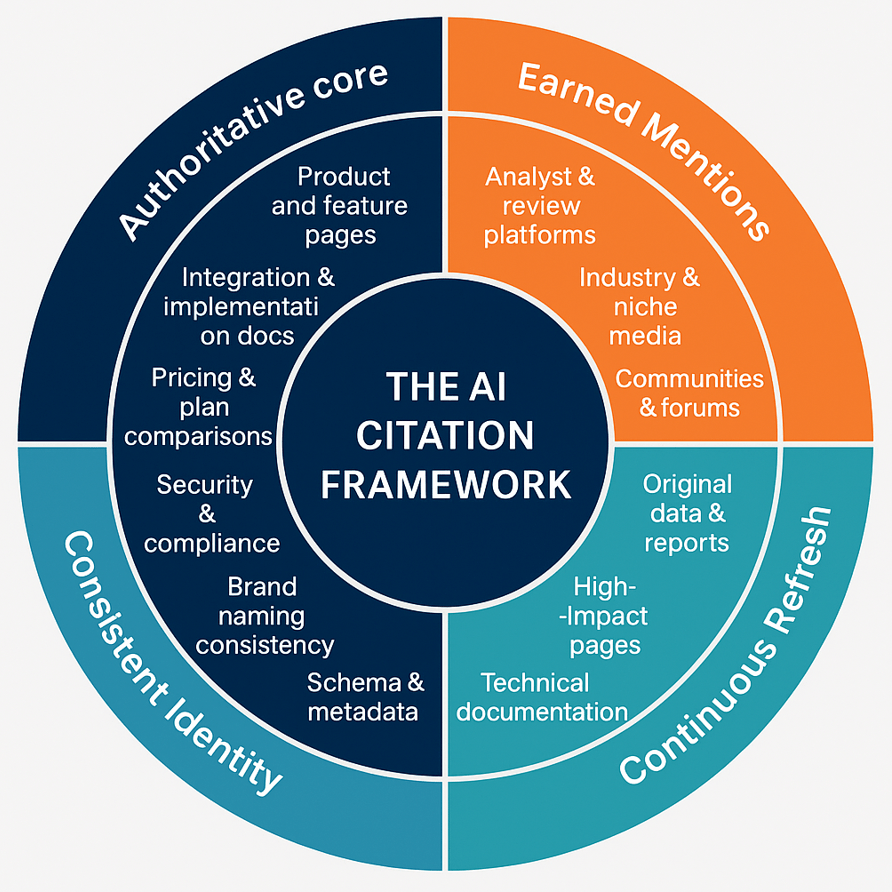
Earned Mentions
Authority doesn’t stay confined to your site and spreads through credible voices around you.
Get your brand featured in analyst reports, software directories, niche publications, and authentic community conversations. When a G2 review, Reddit thread, or Gartner snippet mentions your name in context, that’s what signals relevance to AI models. It’s digital word-of-mouth, and AIs listen closely.
Consistent Brand Identity
AI systems connect dots the same way people do — by patterns and repetition. If your company name, product line, or domain appear differently across listings, the model won’t always realize it’s you.
Keep your organization schema, review profiles, and author pages aligned. The more consistent your digital footprint, the easier it is for AIs to understand that every mention, quote, and document points back to one unified brand.
Fresh Content
Even the best content loses authority when it looks abandoned.
AIs prioritize sources that appear maintained — meaning updated data, recent examples, and visible “last edited” stamps. Make content freshness a discipline, not a one-off project. Update your key pages quarterly, keep product docs synced with new releases, and archive outdated guides that no longer reflect reality.
These four pillars are not about gaming algorithms but about earning trust again and again.
When your content is accurate, your mentions credible, your brand consistent, and your pages fresh, you make it easy for AI systems to treat you as the reliable source in your category.
Let’s look at each of the pillars in more depth –
1. Authoritative Core
This is the foundation of your visibility in AI search – the source of truth your market (and AI models) should turn to first. If a generative engine needs a clean, factual line to quote, it should find it on your site before it looks anywhere else.
That starts with treating your website not just as a brochure, but as a reference library. Every factual question a buyer might ask – from pricing details to integration limits should have one canonical, structured, and easily extractable answer.
When AIs crawl, they are not trying to interpret clever marketing copy but are looking for clarity, consistency, and completeness.
To build that foundation, focus on a few areas that consistently signal authority and clarity to AI models –
Product and Feature Pages
This is where the trust begins. When someone (or an AI) wants to understand what your product actually does, your feature pages should provide clear, factual, and well-structured answers. AI models put accuracy first, and pages with explicit specs, use cases, and constraints help with that. You can use tables to make comparisons, clearly clarify what is and isn’t included, and retain a prominent “last updated” remark.
Integration & Implementation Documents
Documentation is often the most underutilized trust signal on a SaaS site. It’s where your product moves from promise to proof and having detailed guides about integrations and workflows show not just what you offer, but how it works in the real world.
You can make your documents stand out by listing exact platform names and versions (like Salesforce, Slack, or HubSpot) and include technical links where applicable. A well-structured doc page signals maturity AI models interpret as trustworthiness.
Pricing & Plan Comparisons
Pricing pages are magnets for both buyers and algorithms, and yet, they are often the most confusing. AIs frequently summarize pricing insights directly from brand pages, which means any confusion there can lead to misinterpretation.
To avoid this, make your pricing layout easy to scan by using grids, bullet lists, or table and not dense paragraphs. Be upfront about any add-ons, limits, and billing cycles. Such transparency doesn’t just prevent confusion, it also helps AI summarize you accurately and fairly.
Security & Compliance
Security and compliance related content is not just about checkboxes but act as a source of trust. Verified policies like SOC 2, GDPR, or ISO certifications immediately elevate your brand’s credibility both for customers and AI crawlers.
Make sure that this information is not buried inside PDFs or footnotes. Summarize your approach in clear language, link to detailed reports or third-party audits, and explain what these standards actually mean for your users. It makes your claims verifiable – the core of what AIs look for when citing.
Vendor Comparisons
When written thoughtfully, comparison pages are one of the most powerful visibility assets you can create. They demonstrate objectivity something that AI models heavily favor when surfacing sources.
Rather than positioning yourself as better, aim to be clearer. Use factual differences, credible benchmarks, and direct quotes from reputable reviews or analysts to avoid any bias. Such balanced comparisons show confidence and authority in your market.

2. Earned Mentions
If your website builds authority, earned mentions distribute it.
Backlinks used to determine who ranked – now mentions in credible third-party contexts help AIs decide who to cite and trust.
AI systems learn from patterns – they look for brands that show up repeatedly in reliable contexts. When your company is mentioned across analyst reports, software directories, industry articles, or active user communities, it signals consensus. And consensus is what AI models interpret as credibility.
Here’s what you can do to get these valuable mentions –
Analyst and Review Platforms
These are often the first stop for AI crawlers when they gather structured, trustworthy insights. Directories like G2, Capterra, Gartner Peer Insights, and TrustRadius carry built-in authority because they aggregate verified user data.
Keep your profiles up to date, highlight measurable outcomes, and encourage reviews that include specifics metrics, time saved, ROI etc. rather than just positive feedback. The more factual your presence is, easier it becomes for AIs to treat those reviews as reliable inputs.
Industry and Niche Media
Specialist publications and thought leadership blogs hold enormous weight. AIs see them as expert verification – the core difference between an opinion and a citation.
Share frameworks and publish insights that are based on data and can be used by others. A little mention in a well-known specialist publication can do more for your AI visibility than a dozen generic press releases.
Communities and Forums
Real conversations between peers are becoming the new SEO gold. AI answers commonly include Reddit threads, Slack groups, and forums like Stack Overflow or Product Marketing Alliance since they show what real users want.
Be open about your participation in these areas by answering questions, offering use cases, and adding real value without trying to sell something. One well-upvoted comment from a practitioner can be more important than an entire blog campaign.
Podcasts, Webinars, and Transcripts
AI crawlers cannot listen but they can definitely read. If you have a strong podcast or webinar motion, convert that to textual transcripts so that AI models can access and refer them.
Just make sure transcripts are public, well-formatted, and keyword-aligned. These long-form discussions help position your team as credible experts in ways that go beyond written content.
Original Data and Reports
Proprietary data is the most prominent source that any AI model refers to. A single credible statistic or benchmark study can act as an anchor for AI-generated answers across different tools.
You can run small but meaningful surveys, analyse your internal usage data, and publish the findings with clear methodology. Keep the reports easily accessible under a stable URL and not hidden behind forms. In an AI context, every fact you generate is a potential citation waiting to happen.
3. Consistent Identity
AI models learn like people do by doing things over and over again and recognizing patterns. The algorithm might not associate your brand name, product line, or domain as one entity if they seem different on different listings or platforms. That little mistake can slowly make you less visible in AI-generated answers.
The goal is simple – make it impossible for the AI to confuse you with anyone else. Every data point, profile, and author reference should clearly tie back to a single, unified brand identity.
Here’s how to make that happen –
Brand Consistency
Use the same company name and tagline on your website, review sites, and social media profiles to start. Small differences, such using “Inc.” instead of “Technologies” or capitalizing product names in different ways, can make it hard to recognize. AIs look for exact matches, not approximations. Keeping one official version makes sure that every new reference promotes your identification instead of conveying mixed signals.
Schema and Metadata Alignment
Most people don’t know that structured data does a lot of work behind the scenes. Add a “Organization” schema to your main pages and link it to your verified profiles on LinkedIn, Crunchbase, Product Hunt, or GitHub. This helps AI models find the one source of truth for all of your digital assets. Even basic metadata like author names, page descriptions, or logo markup might help people feel sure that the work belongs to the same person.
Author and Expert Pages
Named authors give a brand more credibility by making it seem more human. When your blog entries, whitepapers, or research papers have clear author bios with qualifications and a consistent tone, it shows that real professionals wrote them. Also make it a point to include relevant links such as LinkedIn or past publications and keep the formatting consistent across your blogs and articles. Over time, those profiles develop secondary trust signals that make your brand look more authoritative.
Profile Synchronization
Every major directory or platform that lists your business adds to your visibility graph, which is the network of links that AI systems use to figure out who’s who. The graph gets weaker if your description, logo, or URL are different from one listing to the next.
Check your profiles on G2, Capterra, and Product Hunt often and make sure the information matches the main message on your website. When all the touchpoints are the same, it gives both buyers and algorithms a sense of trust.
Domain and Site Strategy
The way your domain is set up has a bigger effect on AI recognition than you might imagine.
When subdomains are not connected or pages are duplicated, it makes it tougher for crawlers to figure out which page is your official source. You should use canonical tags, connect to other pages on your site, and keep your branding the same throughout all of your documents, blogs, and microsites. Everything should fit together, like chapters in a book, not like footnotes scattered all over the web.
When done well, consistency is like digital gravity. It brings together all the mentions, citations, and backlinks into one orbit that can be seen. And when AI systems can clearly see how all of these things are connected, your brand goes from being one of many to being the default reference in your field.

4. Continuous Refresh
AI systems, much like human readers, assume that up-to-date information is more trustworthy. A page that has not been touched in a year looks abandoned, while one with visible updates signals that someone still cares about accuracy.
The problem is that most B2B SaaS sites go stale quietly. Pricing changes, integrations evolve, and compliance policies get revised and yet the website is not updated. That staleness doesn’t just hurt buyer confidence but it quietly pushes your brand out of AI citation loops.
Freshness is not a cosmetic update – it’s a trust signal. When content is reviewed and maintained, it tells both algorithms and people that your insights reflect what’s true today.
Here’s how to keep your content alive and credible –
High-Impact Pages
Your pricing, product, integration, and security pages are where accuracy matters most. These are also the first pages AIs tend to recheck for updates.
Review them quarterly for changes in specs, features, or limits. Add a visible “last updated” note on each — it’s a small gesture that builds big confidence.
Technical Documentation
Docs act as your brand’s single source of truth and an outdated documentation does more harm than you can imaging. Make sure to align every new release or feature change with an immediate doc update. A good rule of thumb to follow is if the product changes, the docs should reflect it within a week.
How-To and Educational Content
Guides and tutorials get old faster than most teams think and not something that AI models like. To stay relevant, make sure to refresh your content quarterly – revisit top-performing guides, replace outdated visuals, and update steps that no longer reflect your current interface or workflow.
Statistics and Benchmarks
AI models love statistics, but they don’t care about old data. If your blog talks about a “2022 study,” it’s already behind someone who talks about data from 2024.
Check your material for old stats and update them once a year. When you use numbers, make sure to say where they came from and what year they were published. This makes both people and machines more credible.
Content Structure and Schema
Even the best of your content will remain invisible to AI if it is not read & understood by the AI crawlers. To make sure that this doesn’t happen, refresh your metadata, schema markup, and FAQ sections regularly. Updating timestamps, adding new FAQs, or restructuring headings helps AI systems recrawl and understand your content’s current intent.
Measuring Success in the AI Search Era
You can’t improve what you can’t measure and the same rule applies to AI visibility.
The challenge is that traditional SEO metrics (impressions, backlinks, click-through rates) don’t tell the full story anymore as AI discovery works differently. You’re not competing for clicks on a results page – you are now competing for citations inside an answer.
Marketers now need a new layer of analytics – one that tracks how often, where, and in what context AI systems reference their brand. Think of it as the new “share of search” but across LLMs.
Here’s a practical way to start –
| Metric | What It Measures | Why It Matters | How to Track It |
| AI Citation Mentions | Number of times your brand or domain is cited in AI-generated answers across ChatGPT, Gemini, and Perplexity. | Direct visibility signal shows if the model considers you a trusted source. | Use AI search tracking tools (like GeoRankers) or manual prompt testing each quarter. |
| Third-Party Mentions | Growth of credible external references — media, analyst reports, review sites, community threads. | Expands the evidence graph AIs rely on to understand brand authority. | Set up Google Alerts, Brand24, or Mention. Tag credible vs. low-quality mentions. |
| Content Freshness Index | % of your key pages updated within the last 90 days. | AI crawlers prioritize recently maintained, reliable content. | Track publish dates and “last updated” stamps in a dashboard. |
| Entity Consistency Score | % of major listings with matching brand name, logo, and URL. | Proves AIs can confidently connect all your properties to one entity. | Audit G2, LinkedIn, Crunchbase, Capterra, and schema fields quarterly. |
| Citation Readiness Score | Share of pages that include a short factual summary, structured layout, and FAQ. | Measures how easy your content is for AI to quote accurately. | Evaluate top 100 URLs using a simple internal checklist. |
You don’t need dozens of tools to get started.
Begin with manual checks – prompt ChatGPT or Gemini with questions like “What is the best software for [your category]?” or “Compare [your brand] vs [competitor].”
Document how often your name appears, how it’s described, and which sources the AI cites. Over time, these patterns will reveal where you are trusted and where you are invisible.
To Conclude..
AI search is reshaping how authority is built online.
Where backlinks once decided visibility, citations now decide credibility and earning those citations is not about gaming the algorithm but about earning trust at scale. So, the brands that consistently maintain clear, factual content, get referenced by credible voices, and stay recognizable across the web will naturally rise in AI-driven discovery.
The question then every marketer should ask now isn’t “How do I rank higher?” but “When AI explains my category, does it mention me and does it get the story right?”
If not, it’s time to fix it.
Frequently Asked Questions
1. What exactly are AI citations, and how are they different from backlinks?
AI citations are references made by AI models (like ChatGPT, Gemini, or Perplexity) when they include your content as a source in their answers. Unlike backlinks, they aren’t votes from other websites – they are acknowledgments of trustworthy information. While backlinks boost ranking, citations boost credibility within AI-generated results.
2. How do AI models decide which sources to cite?
Large language models prioritize clarity, accuracy, and consensus. They are more likely to cite content that is factual, structured, and mentioned across multiple credible sources (like review sites, analyst reports, or community discussions). Marketing fluff or vague copy usually gets ignored.
3. Can traditional SEO help improve AI citation visibility?
To some extent, yes but not entirely. Technical SEO and content structure still matter because they help AIs crawl and interpret your pages. However, AI visibility also depends on how often and where your brand is mentioned, the recency of your information, and the consistency of your brand identity across the web.
4. How can B2B SaaS companies track their AI citations?
You can start manually by prompting ChatGPT, Gemini, and Perplexity with queries like “best software for [category]” or “compare [your brand] vs [competitor].” Document where your brand appears, how it’s described, and which sources the AI references. Tools like GeoRankers are emerging to automate this process across multiple AI platforms.
5. How often should we refresh our website content for AI visibility?
Review your high-impact pages like pricing, product, documentation, and integrations every quarter. Update data, screenshots, or terminology, and add a “last updated” note. Freshness is not just cosmetic – it tells AIs that your content reflects the most current insights.
6. What’s the single biggest mistake brands make with AI search?
Treat this just as SEO 2.O. AI search isn’t just about SEO and ranking – it’s about representation. You can rank first on Google and still be invisible in an AI-generated summary if the model doesn’t trust your information. The goal is to make your brand quotable, verifiable, and recognizable everywhere AI looks.


 GeoRankers Blogs
Leave a comment